Tuesday, March 22, 2016

Make it Personal!

Most clubs have performed at least a few new member inductions by this time of the Rotary year. Did you know that how you conduct your induction can be a critical first step to engaging and retaining that new member? In the past we were taught that the induction was very important, but the focus was mostly on explaining to the new member what a great organization he or she was joining.

Current thinking is that we should shift the focus of the induction away from educating the inductee about Rotary, to a more personal induction. One that helps to educate the club about who is being inducted. Where are they from? What kind of family do they have? Do they have children? What age(s)? Where do they attend school? What does the spouse do? What are their professional skills and abilities? What are their personal interests and hobbies? When these questions are answered in an induction ceremony, some magic begins to happen.

People sitting in the audience find things in common with the new member. They are more likely to strike up a conversation afterwards. The new member feels more valued, and their family understands that they can be as much a part of Rotary as they want. Basically, the personal induction begins the process of developing the glue that retains members and binds them to their clubs. That glue is friendship, the number one reason why people choose to stay in Rotary!

If your club would like to update its induction ceremony, there is good news! There is a "personalized Induction" template that is now posted on our District 5190 website (rotarydistrict5190.org), in the Membership Development section. For a short cut, just click HERE to access this great tool for improving your new member retention by getting off to a great start.

That's All!

Friday, February 12, 2016

Don't Rush the Question!

Research has shown that only a little over 10 percent of Rotarians ever sponsor a new member into Rotary. So for many club membership chairs, getting folks to invite prospective members to a  meeting is a problem. However, sometimes we can get a little little anxious with the question, and that should be avoided too.

When you "pop the question" to an unprepared prospective member, many times you are forcing them to decline. After that, it can be very difficult for them to be persuaded to change their mind. So, asking them to join right off the bat is usually counterproductive.

The better approach is to think of it as a kind of "dating" process. You want to demonstrate to them that your club is worth their while. That is a process that begins with an invitation to be a guest at a club meeting, NOT asking them to join. How many of you fellows out there walked up to a young lady you were interested in and asked her to get married the first time you met?

Don't rush the question of membership!
No, we want to invite them to learn more about Rotary, not to join. The invitation to join only comes after you have gotten to know them; they have come to know you and your club; and it seems like it will likely be a good fit for "all concerned".

Make sure you think about how you will make "the Ask" (see Sept. 4th, 2015) and don't forget to prepare your club. Make sure it is going to be a good program, and get help from your fellow members in making sure your guest feels welcome. Make extra sure no one blurts out: "So, when are you going to join?" during the meeting. Rushing the question may put your guest under pressure, and spoil their first impression of your club.

So remember, to develop a strong and lasting relationship between Rotary and new members, take it slow, and don't rush the question!

Monday, January 18, 2016

Cheers!

As we enter the second half of the Rotary year, we are all focused on hanging on to the gains we have made in membership. On New Year's Eve most of us raised a glass and toasted last year, and next with a hardy  CHEERS! It reminds one of the old TV series Cheers, where each week we followed the exploits of a group of very close friends who met regularly in a bar. The name of the bar? Cheers. What made it so special? Everyone new each other's names, and when you got there, they were "always glad you came." A warm, welcoming and friendly place.

What a great way to approach making your club more attractive. Is your club like Cheers? How can you make changes that would make visitors feel even more welcome? How about your current members (especially those newer ones)? Does everyone know their names? What's more, do they know what they do in their work lives?

There are lots of creative ways to enhance your meetings to make them more fun and welcoming. One excellent idea is to invite a "Mystery Visitor" from another club that is unknown to your club. Have that person come to a meeting and afterwards give an honest appraisal of what kind of impression your club made on her/him. Put this information to use to "Cheer Up" your club and make it even more attractive to current and prospective members.

Saturday, December 19, 2015

Engagement is the Key to Retention

As we near the halfway mark of the year our membership focus needs to be squarely on retention. Many clubs have added a significant number of new members. Unfortunately, all to often we lose as many (and sometimes more) out the back door as come in the front. Now is a critical time to stand up your retention committee, and start canvasing your members on how satisfied they are, and finding out how to properly engage them in your club.

For new members, the "12 Letters" is a great way to reach out to them and let them know how much you value their membership in the club. This program is explained on our District Membership Development page. Here is a link to the "12 Letters" program on our District website:


Just scroll the page down and look for the 12 Letters heading!

For members that have been around for a while, make sure you are calling those who may have missed a few meetings lately. Let them know that you and the rest of the club miss them. Make sure they are getting the return on their investment of  time and money that will make membership in your club worth it! Set up some holiday social events, and make sure those that have been out of the loop get a special invitation to come. You could also add a holiday service project to your club's suite of activities. Go caroling, or be a secret Santa at the local battered women's shelter. The main idea is to get your members, new and old, engaged in your club. That is the glue that keeps them coming back, and will give your club the vitality to continue to serve your community far into the future!

That's All!

Wednesday, November 11, 2015

How Do We Treat Our Guests?

Any club member can do a great service for membership development in her or his club by focusing on how they treat guests at their club meetings. Remember, they are not only visitors, but potential new members as well. They are going to form a first impression of your club no matter what:

  • Their eyes will see your meeting room and everything in it … what will they see?
  • Their ears will hear what is (or is not) said to them, and what is (or is not) said to others, before and during the meeting … what will they hear?
  • Their hand will (or will not) shake the hands of members and other guests …who will they meet?
  • Their mouth will (or will not) speak to members and others in the room … who will they talk to?
Any member can have a tremendous positive impact on a guest's first impression by treating them like the special people they are. You should show them how glad you are that they came, and express that to them. You should be interested in learning more about them: their name, vocation, do they have a family, how long have they been in the area, etc.


How do you feel when you walk into a room full of strangers, and few people even acknowledge that you are present? Has that ever happened? It happens all too often. When it does, we miss a great opportunity.


Alternately, how do you feel when entering the same room and people approach you with a smile on their faces, and their hand outstretched, letting you know how glad they are that you could take some time out of your day to come and visit. How would it make you feel to be invited to sit with them at their table? 

Remember, we don't get a second chance at first impressions. By going out of your way to give your guests special treatment, you will expand your own circle of friends, make someone else's day, and perhaps, just perhaps, help your club build its membership!

That's All!

Sunday, October 11, 2015

A Real Mentor, or Just a Check in the Box?

Most clubs have the biggest retention problem with newer members. That is, members who have been in the club for less than a year, 1 to 2 years, and 3 to 5 years. The key to hanging on to more of the new members that you put so much effort into is to ENGAGE them!

Engaging new members in the workings of the club is crucial to
 improving New Member retention rates

Assigning a mentor is a good idea, but make sure that you give clear direction on what you want that mentor to do. Too many clubs that I know of just pick a person and say "tag you're it". It is crucial to make sure that your mentors are not over loaded, understand the expectations from them, are WILLING to do the job, and finally, report back to the membership committee on a periodic basis. 


You don't have to start from scratch, there is great information available on our website. Just click the link below and view it! There is additional information on engaging new members there as well.


You can find lots of tools to improve your mentoring program
on the District Website under membership development.
Bottom line is that the first place for most clubs to get started in enhancing their retention is to focus on your newer members.

That's All!

Woody

Friday, September 4, 2015

What's Rotary?

How many times have you been asked the question: "What's Rotary?" only to have a difficult time coming up with a concise way to describe this movement we all know and love. These are great opportunities to reach out and interest potential new members, but we have to be prepared.

Be ready for the opportunity to
answer the question: "What's Rotary?"
When someone asks you "What's Rotary?" you have about 2 seconds to start to say something. After that, you only have about 20 seconds to "set the hook" and generate some interest in Rotary. If you go on much longer and the people are not interested, you'll bore them, if they ARE interested you'll be preventing them from asking questions. Here is a great answer to the question, that is short and succinct, and hits on the primary reasons WHY people join and stay in Rotary.

"It’s a leadership organization…We’re made up of local business, professional and civic leaders. We meet regularly, get to know each other, form friendships, and through that, we’re able to get things done in this community."

This simple answer is a great tool to start a deeper conversation about Rotary with those who are interested. Memorize it and have it at the top of your toolbox to use the next time someone asks you: "So, what's Rotary?"

That's All!

Monday, August 3, 2015

Why Did You Join Rotary?

Why do people join Rotary? This is a great question and the answer holds the key to igniting membership development in your club. Rotary International recently engaged a consulting firm, Sigel and Gale, to get the answer to this question and more. The purpose was to better understand how we as Rotarians can turn around the shrinking of Rotary in North America.

Sigel and Gale interviewed 20,000 Rotarians to come up with some answers that you can use to help your club grow. They found that the majority of people JOIN and STAY in Rotary for two primary reasons. They join to have a positive impact locally, and to forge friendships. They stay for the same reasons. Other factors are networking, personal and professional recognition, training opportunities, and to have a positive impact globally. Local factors make up over 90% of the reasons folks join our great                                                                                     organization. 


Here is the "bottom line of what our members value in Rotary:


  1. Friendship
  2. Local Impact
  3. Vocational Respect (value me and my work)
  4. Leaders to work with 
When we think of Rotary as a business, we often think of our customers as the beneficiaries of our service. It follows that our "product" would be the service we provide to our communities. In light of the knowledge provided by Sigel and Gale we need to change the way we look at this if we are to have a resurgence as an organization. Our customers are our members (and prospective members). Our product is friendship, opportunities to have local impact, giving vocational respect, and working together as leaders.

Once we know and understand this, it is simply a matter of making sure our customers (and prospective customers) get what they want out of membership in our clubs. If we weave our product into our approach to Attraction, Engagement, and thus Retention our clubs will grow and prosper like never before. As a result, Rotary will become even more relevant in making the world a better place, one community at a time.

That's All!

Wednesday, July 15, 2015

Get off to a Great Start!

August is Membership Month. Now that the Rotary year is beginning to settle in with new officers and leaders at the helm, it is a great time to make more progress to develop membership in your club. Developing a written plan and getting it done is critical to a successful year for your club.

Get to know your fellow Rotarians!

When we talk about membership development we usually think of the broad categories of Attraction (bringing in new members), Engagment (making sure that ALL of our members are engaging to get what they desire out of Rotary), and Retention (a product of being an attractive and engaging club). In the broader sense, membership development is simply about building great relationships with our fellow Rotarians, and sharing our Rotary experience with others. Membership development is the glue that binds our clubs together into fun, productive and stable units. A Membership Development Plan is the biggest thing you can do to help make your club stronger and more effective.

To view the plan in detail, click the link below:


The plan is divided into three time frames, NOW, 30 Days, and 90 Days. A few examples of the NOW action items are:


  1. Identify all of your new members (24 months or less)
  2. Reach out to them and identify or clarify their interests and expectations from membership.
  3. Start "New Members Letters" (for more on this, click this link: here)
What a great place to start. Usually members in your club for two years or less are the most vulnerable to dropping out. 

A few of the 30 day items are:
  1. Review and update your club website and or Facebook page.
  2. All members develop and practice how they would ask a prospective member to come to a meeting.
  3. Assign a greeter, and establish protocols for making all feel warmly welcomed.
By 90 days the results will start to show if the plan is being implemented.
  1. Members have learned more about each other, and laid the groundwork for stronger friendships.
  2. Guests/visitors consistently feel welcome to the club meetings.
  3. All members are engaged with an assignment.
Use this plan to get a start on a great year in your club! Remember, this is a great way to get a quick start, and then later develop some more action items to enhance the plan and develop membership. Plan to come to the Membership Seminar on September 19th to get more information that will help your club grow and have the best year of service yet!

That's All!

Thursday, August 14, 2014

Develop Your Membership: Make a Plan!

August is Membership Month. Now that the Rotary year is beginning to settle in with new officers and leaders at the helm, it is a great time to make more progress to develop membership in your club. Developing a written plan and getting it done is critical to a successful year for your club.

Our meetings are a great place to get to know each other.
When we talk about membership development we usually think of the broad categories of Attraction (bringing in new members), Engagment (making sure that ALL of our members are engaging to get what they desire out of Rotary), and Retention (a product of being an attractive and engaging club). In the broader sense, membership development is simply about building great relationships with our fellow Rotarians, and sharing our Rotary experience with others. Membership development is the glue that binds our clubs together into fun, productive and stable units.

At the Membership Seminar held this month, a short and ready made plan for enhancing membership development in your club was presented. To view the entire plan, click the link below:


The plan is divided into three time frames, NOW, 30 Days, and 90 Days. A few examples of the NOW action items are:

  1. Identify all of your new members (24 months or less)
  2. Reach out to them and identify or clarify their interests and expectations from membership.
  3. Start "New Members Letters" (for more on this, click this link: here)
What a great place to start. Members in your club for two years or less are the most vulnerable to dropping out. 

A few of the 30 day items are:
  1. Review and update your club website and or Facebook page.
  2. All members develop and practice how they would ask a prospective member to come to a meeting.
  3. Assign a greeter, and establish protocols for making all feel warmly welcomed.
By 90 days the results will start to show if the plan is being implemented.
  1. Members have learned more about each other, and laid the groundwork for stronger friendships.
  2. Guests/visitors consistently feel welcome to the club meetings.
  3. All members are engaged with an assignment.
Develop a plan for this year and put it into action!
Use this plan to get a start on a great year in your club! Remember, this is a great way to get a quick start, and then later develop some more action items to enhance the plan and develop membership.

That's All! 

Saturday, April 26, 2014

Is your "Elevator Speech" ready?

One of the key aspects of membership development is getting prospective new members interested. Often we stumble into an opportunity when someone asks us: "What is Rotary?" (Maybe they saw that pin that you always wear so proudly.) When the opportunity arises, it is very important to have a short, succinct, and accurate answer to this proverbial question. The answer must also include our personal "Why" of Rotary membership.

Often, caught unprepared, we may expound on the internationality of Rotary, the size and scope of our service, or that we meet every week and eat together. None of these are particularly good at catching someone's interest in 15 to 30 seconds. So, first ask yourself: why did you join and what keeps you coming back? If you are like many Rotarians, the two most cited reasons that people join are for the networking and friendship, and to make their LOCAL communities a better place for all. About 75% of Rotarians joined (and stay) for these reasons.

Rotarian Michael Angelo Caruso
Jim Henry, a Rotarian from Florida, says that your response must address your club's "target audience" of business, professional, and community leaders. If they are in one of these categories, your club would most likely benefit from their membership. So, what is Rotary?  Henry's approach would be to answer: "Rotary is a network of active and retired business, professional, and community leaders, committed to making our community a better place to live." If the person who is asking is an active or retired business, professional or community leader who cares about your community, they will probably ask for more information.

Rotarian Michael Angelo Caruso customizes his "elevator speech" for specific target audiences. He simply
says: "Rotary is the best decision I ever made!" That certainly will spark interest in almost anyone. Play the video below for more from Michael on his intriguing "elevator speech".


So, the key points are to prepare yourself, think of your "target audience", and be ready to respond in a way that will stimulate further interest and discussion when the right person asks you: "So what is Rotary, anyway?" There is nothing worse than to have someone ask and your response is: "ummmmm..."

That's All!

Woody


Monday, April 7, 2014

Engage Your New Members


Engagement is the key to developing and retaining great Rotary members. Engagement shows them you care, and helps them build a habit of participation with you and your club. It really is the glue of retention!

Engagement is the key to growing great Rotarians and future
club leaders.
There is a new tool that DG Vicki has put together for your use on our website. There are a total of 12 letters all written and ready for you to fill in the blanks and customize. The letters are intended to engage and help orient new members. They are designed to be mailed to a new member weekly (or whatever interval you decide) to help inform and welcome them to your Rotary club, based on the belief that new Rotarians benefit from understanding the basic tenants of Rotary, as well as specific information about your club. This is a fabulous tool! Imagine how your recently inducted member will feel about your club after receiving these letters. You can get your club secretary involved to help you, or appoint a member of your committee to
accomplish this important task. Here is the first one as an example:

Dear new member:

Congratulations on your acceptance to membership in the Rotary Club of Downtown Metro.  It is with great pleasure that every member of our Club welcomes you to this Rotary Club and to our International Organization.

This is the first in a series of twelve letters that you will receive weekly to convey important elements concerning Rotary, its purpose and mission.  We ask that you give careful attention in your reading of the letters to help you understand more about Rotary and to assist you in engaging in the activities of our Club and Organization.

You have been invited to membership because your Sponsor recognized you as a person of good character and reputation, a leader in your profession. a leader in the community and saw in you the “heart of service”.  Although you have been invited to join Rotary, it will be through your own actions that you become a Rotarian—a term that means much more than just being a member of a Rotary club.

The first thing we ask is that you attend the Club meetings each week.  In this way, you will have the best opportunity to meet the other Club members and learn about the activities of our Club.  Each of our members will make an effort to make you feel welcome, will to get to know you and then we ask that you also do your part.  Plan to participate in the weekly meetings as a greeter so that you can become familiar with the other members.  Sit at different tables each week to enhance your exposure to more members.  Volunteer to sell raffle tickets at the door, or to take notes for the weekly newsletter.

There is no probationary period in Rotary.  You are a Rotarian, just like every other Rotarian in our Club or in the world.  First names are the custom that denotes we are all equals in Rotary.  Reach out your hand in friendship to all the other members and introduce yourself.  The members will be interested in learning about you, your profession, your family and your hobbies. Through this interaction, you will also get to know each of our members.

Personal acquaintance and friendship are the cornerstones of Rotary and attendance at each meeting is very important to our Organization.  Rotary meetings are held each week and you are expected to attend at least 50% of the time.  Greater attendance is encouraged because the absence of any member deprives the Club of the value of our diversified membership, contributions of all members to ongoing club projects and the personal fellowship of each member.  You will find that you miss a lot when you miss one of our meetings!

Please speak to me, or to any of the other Rotarians in our Club, with any questions.  I look forward to seeing you at this week’s meeting.

Yours in Rotary Service,

Club President

Think of the impact that receiving these letters would have had on you when you first joined! Make sure you customize them to fit your club, and start engaging your new members right away.

You can download copies of these letters from our membership development section of the district website, or at the following link:


That's All!

Woody

Thursday, April 3, 2014

Retention: How is your club doing?

Retention is a word we all hear when discussing Rotary membership. I thought I understood what it meant until I was tasked with calculating it for my club. Most of us understand that the "retention rate" is essentially the percentage of club members who stay in the club (as opposed to terminating their membership). However there are several questions and assumptions that must be made before you can do any calculating.

  • What time period are you going to use?
  • Do you want to know the percentage of  "new members" that stay with the club?
  • How about the percentage of existing members that hang in there?
  • Why should we care?
I'll start with the last question first: why should we care? When I was club President in 2001, Rotary touted 1.2 million members in round numbers. Today, we are still at 1.2 million members world wide. However, it may surprise you that over that period we inducted about 1.2 million new members! So, 1.2 million members left Rotary over that time frame! We had essentially ZERO growth even though we added over a million members world wide. So, getting people to join is something we are pretty good at, but we are losing members as fast as we can replace them.
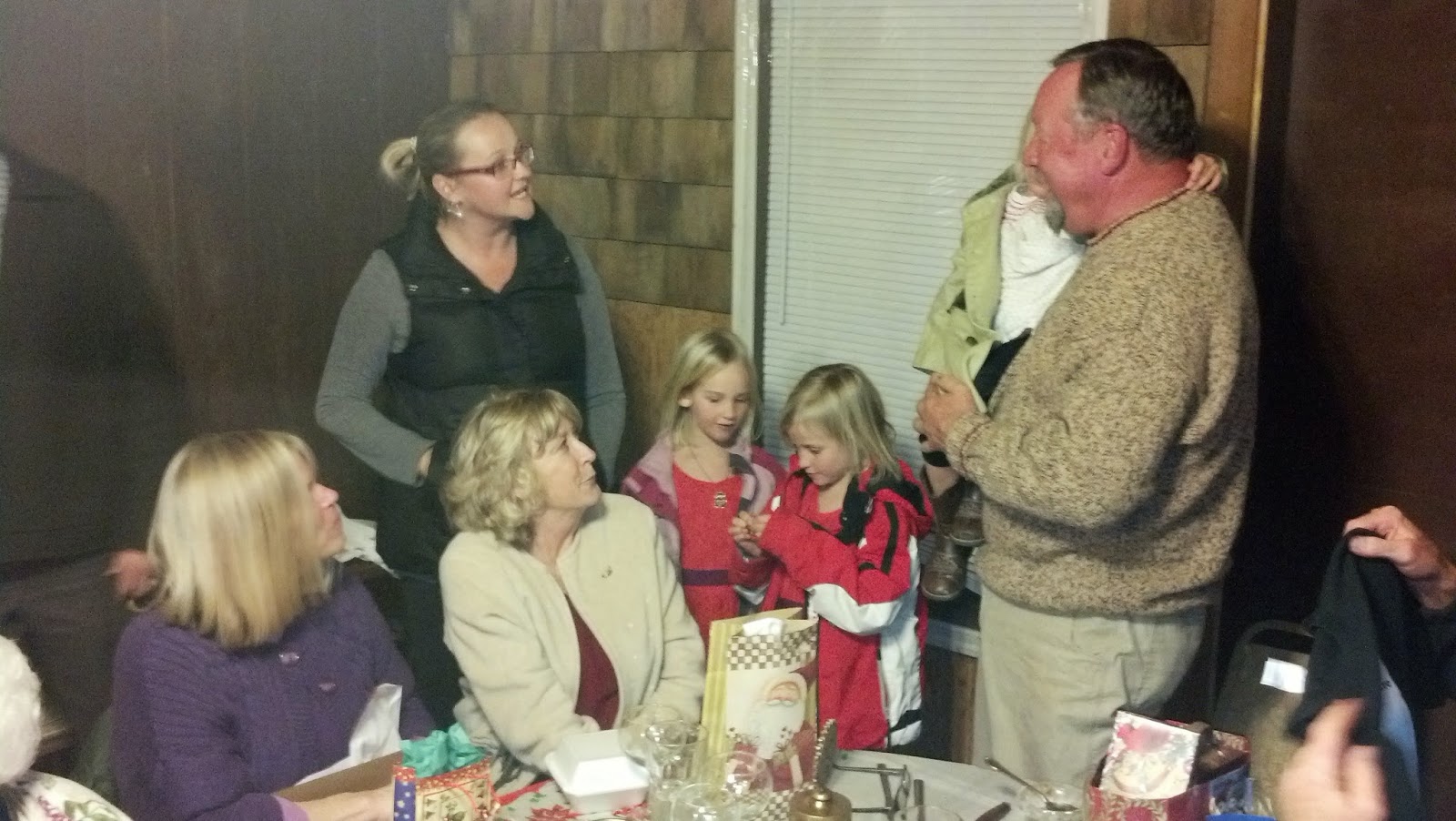
Family friendly meetings and events can really improve
retention rates!
In District 5190, we have lost over 1,600 members since July 1, 2008. That means that the equivalent of 63% of our current membership has left the Rotary fold over the last 5 years. The story is similar (and sometimes worse) for many clubs.

But retention is the percentage of members who STAY over a given period of time. So we must first set the time we want to evaluate. It's a good idea to use more than just one year so you can get a feel for what is happening in the club. RI recommends using 3 to 5 years of data.

Besides the time period, it is useful to understand how well your club retains new members versus existing members. This is because there may be different reasons influencing these two rates of retention. Figuring out the existing member retention rate is straight forward. Your starting number is the existing membership at the start, your ending number is the number of those same members who are still in the club. You divide the remaining (retained) members by your start number, and multiply by 100 to convert to a percentage.
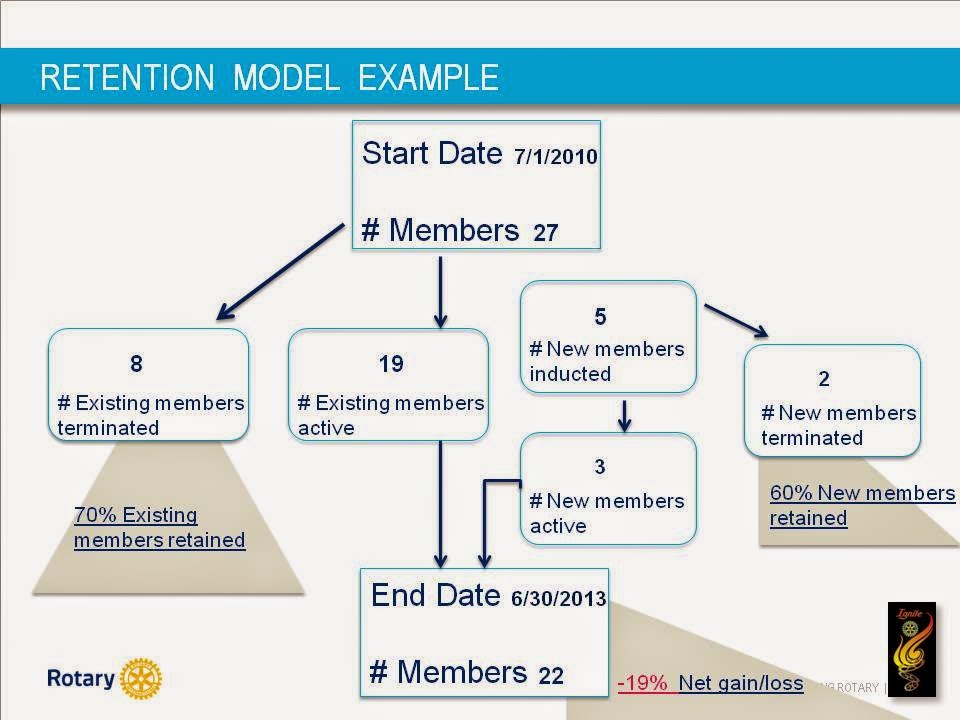
Here's an example of a Retention Model that gives valuable
information about your club.
Let's say we start with 27 members, and 8 leave the club. That leaves 19 of the original members still chowing down lunch on Thursdays. Nineteen divided by 27 times 100 equals 70 percent. That is your existing member retention rate.

The math is the same for new members. However your starting number is the total number of inductees during the period in question. You subtract the number of new members who didn't make it through the period before they drifted away, then divide by the start number. 

So, let's say that during the same period, we inducted a total of 5 new members, but 2 of them just didn't seem to "take". That leaves only 3 of the new members in the club. Divide 3 by the 5 total inductees and multiply by 100 to get a retention rate of 60 percent.

You will be surprised to look at your club's data. By examining this information you can assist in putting together a plan that will help address the problem in your club. To make it easy for you, your club's data for the period July 1, 2010 to July 1, 2013 can be found by clicking on the following link: 


Also, to assist you in evaluating your club's retention rates, a blank "Retention Model" form similar to the illustration above, can be accessed at the following link:


Finally, some additional historical information about your club's membership over this same time period can be found here:

With this information you can perform a valuable service to your club. Look it over, make the calculations and share the information with your board. Brainstorm ideas to address retention issues. We need to increase our rates of retention significantly (let's shoot for 85% or above in both categories!) if we are to grow Rotary so that it we can do even more good in our communities, and the world!

That's All!

Woody


Tuesday, February 11, 2014

We Must Care!

A strong membership program makes a club more stable and resilient. It works both ways, strong resilient clubs are that way because they are meeting the needs of their members at a high level. This gives them a great retention rate, and makes them attractive to new members. In order to develop and institutionalize a strong membership program, we must care about the well being of the club. It takes planning and work, but will pay off big time.

A program developed in District 5170 a while back, is aptly named the "We Care" program. This program is a well thought out process to energize your club. It is totally compatible with the Ignite program, and if you use it as a guide, you will score major points on the Ignite score-sheet. You can find the program on our District website under Membership Development. I thought I would include an excerpt on how to treat new members here for you.

The Rotary Club of Reno is a large club that must continually
work on membership development.
First, on the very day (or before) a new member is inducted, the club should assign him/her two or three Rotarians that will be mentors. The mentors must understand that they are the key to insuring that the new member enjoys Rotary.

A mentor’s job will consist of inviting new members to sit with them at meetings. Make sure that the new member is introduced to each member at the table. By involving new members in conversation at the table they will feel more like they are part of the club. Generally most individuals are shy and they need help meeting new friends. Remember, the quicker we can make our new members comfortable, the more receptive they will be, which will result in making a happier and more productive future Rotarian.

A mentor must take the initiative to invite new members to all District and Club events. A personal invitation by phone always gives a feeling of caring and warmth. Take time during the phone conversation to explain what the event is about. This helps create interest from the new member. At the actual event follow up with more information so the new member understands more completely why it’s important to attend the event and what the objective of the event is.

Immediately assign the new member to a committee that provides interaction
with other club members. This assignment should give them a sense of accomplishment but shouldn't be so difficult that it becomes a burden that in turn leaves a negative attitude about Rotary. The committee should also help build camaraderie.

Always give the new Rotarians avenues to meet members quickly. The quickest way is to ask them to be club greeter. Make sure that other Rotarians who are familiar with the entire membership are assigned to work by their side. You must direct the Rotarian to make a conscious effort to introduce the new member to all Rotarians attending the meeting.

These two Winnemucca Rotarians are checking up on
their "Buddies" who missed last week before their meeting
starts.
If members miss two meetings make sure that a club representative calls them to find out why they missed. Make sure that they are told that the club missed them and be sure not to create a feeling of reprimand.

Each month new Rotarians should be met with, and casually talked to, regarding their feelings about Rotary. Ask them what they would change or modify if they had the opportunity. As our clubs age we seem to get tunnel vision. This is a great opportunity to get new ideas and input. It will also provide an indication whether the new member is enjoying Rotary and if they want to remain a member. All negative feelings must be reported to your membership committee and your club Board of Directors, so that remedial action can be considered.

Remember, "New Members" are those that have been in the club for 2 or three years or less. Statistics show that these are the most likely to leave the club. Don't fall into the trap and take new members (or any members) for granted. How long was it before you really got bitten by the "Rotary Bug"?

In the last 6 years our District has said goodbye to 1,655 Rotarians! Just think what more effort at better retention would have done for your club, the people in your community and around the world!

That's All!

Woody

Monday, February 3, 2014

Treat Your Members as Customers!

Sad Story: How many times have you brought in that new member only to see them leave within a few years? Unfortunately this is all to common. Our highest attrition rate in Rotarians is within the first two years. It is not unusual to find clubs that have said goodbye to enough new members over the last 5 years to DOUBLE THEIR CLUB SIZE. 

Members as Customers: You can stop the revolving door by treating your members as a successful business treats its customers. How many highly successful businesses operate by simply assuming that new customers are totally satisfied, and will forever keep coming back? Not many. We need to know what our current membership wants, and then have the courage to make changes in the club to satisfy those "customers".

Surveys and Assessments: Member Surveys and assessments can be a useful tool to make sure your club is serving your members' needs. The RI Annual Member Involvement Appraisal is one such tool. Another is the RI Member Satisfaction Questionnaire. Using either or both of these tools is a great idea, and scores big points on your Ignite Score sheet. You can also host informal discussions, or create "member focus groups". The key here is to find out what will engage your members and develop them into strong and committed Rotarians. Be sure to involve former members of your club as well.

Implement the changes: The hard work is to actually take action in your club to adapt to the needs of your members. We all to often blame new club members for dropping out. "They just weren't cut out for Rotary" or "They just didn't fit in." My favorite is: "They were just here for business networking". Vocational Service is one of the Five Avenues of Service! I know I joined for networking, and I was successful in that first Rotary endeavor. It wasn't until after that, that I caught the Service bug! Bottom line is that your club needs to make the difficult leadership decisions that are necessary to adapt the club to the changing needs of its members.

Make it worth their while: People have a limited amount of time, and as a Rotary club we are competing for that time. You must make your club worth their while. So meeting the needs of your newest members (customers) is crucial. Just like a business wants to ensure its new customers are satisfied so they will keep coming back, you can ensure that your new members are satisfied, so they stick around and have the chance to grow into great Rotarians of the future!

That's All!

Woody


Monday, January 13, 2014

Halfway There!

Welcome District 5190 Membership Chairs! This new Membership Blog is designed to keep you up to date on membership ideas, issues, activities, and program elements that will keep your club stable and growing. There is just so much going on in the arena of Membership, that I think that it might be best to get it out in a little smaller "bite-sized" chunks. Of course a great resource is our District 5190 web site http://www.rotarydistrict5190.org/ . Any resources that I refer to in this blog will be found on our website under Membership Development.

We're Halfway There: Not only are we about halfway to our goal of a net gain of 100 new members, we are halfway through this Rotary year. Amazing how time flies, isn't it? Let's gear up and start the big push to end the year with success!

Update: Our current membership number for the District is showing as 2,503 active members on the Club Runner summary.  That's a gain of 60 from our July 1st SAR number. However, we need to intensify our focus for the second half of the year, especially our focus on retention. Last year we netted 8 new members district wide. We accomplished this by adding about 208 new members, and losing about 200! I know we can do better this year with increased effort and focus by you and your committee during the 2nd half of the year.

Ignite: This year fewer clubs are participating in the Ignite Membership Program. We need to turn this around. Last year we had 41 clubs attain "Premier" status in the program, with a total of 47 participating at some level. Premier clubs were very successful. They grew by an average of 4%, while non-Premier Clubs shrank by 2% on average. Please, if you are looking for a relatively easy way to "Ignite" your club membership, give me a call (530-906-2253) or email me (woody5190@gmail.com) for info. on implementation of the Ignite Program. We are flexible, and want this to work for you and your club.

Engage your new members: Engagement is the key to developing and retaining great Rotary members. Engagement shows them you care, and helps them build a habit of participation with you and your club. It really is the glue of retention! There is a new tool that DG Vicki has put together for your use on our website. There are a total of 12 letters all written and ready for you to fill in the blanks and customize. The letters are intended to engage and help orient new members. They are designed to be mailed to a new member weekly (or whatever interval you decide) to help inform and welcome them to your Rotary club, based on the belief that new Rotarians benefit from understanding the basic tenants of Rotary, as well as specific information about your club. This is a fabulous tool! Imagine how your recently inducted member will feel about your club after receiving these letters. You can get your club secretary involved to help you, or appoint a member of your committee to accomplish this important task. Click on the link below to go directly to the Membership Development page. (You might have to log in first.)


That's all for now. Stay tuned for more Membership information on this District 5190 Membership Blog!!

PDG Woody
D5190 Membership Chair